
Michigan had its first bye week of the season after starting 8-1-0. The team’s seven straight wins to open the season matched last year’s start and the program’s best. The Wolverines are currently No. 2 in the NCAA after a brief stint at No. 1. We’re a quarter of the way through the season, so I’d like to do an early-season review. I’ll give my thoughts on the team and dive into the stats and analysis.
Team Stats Analysis
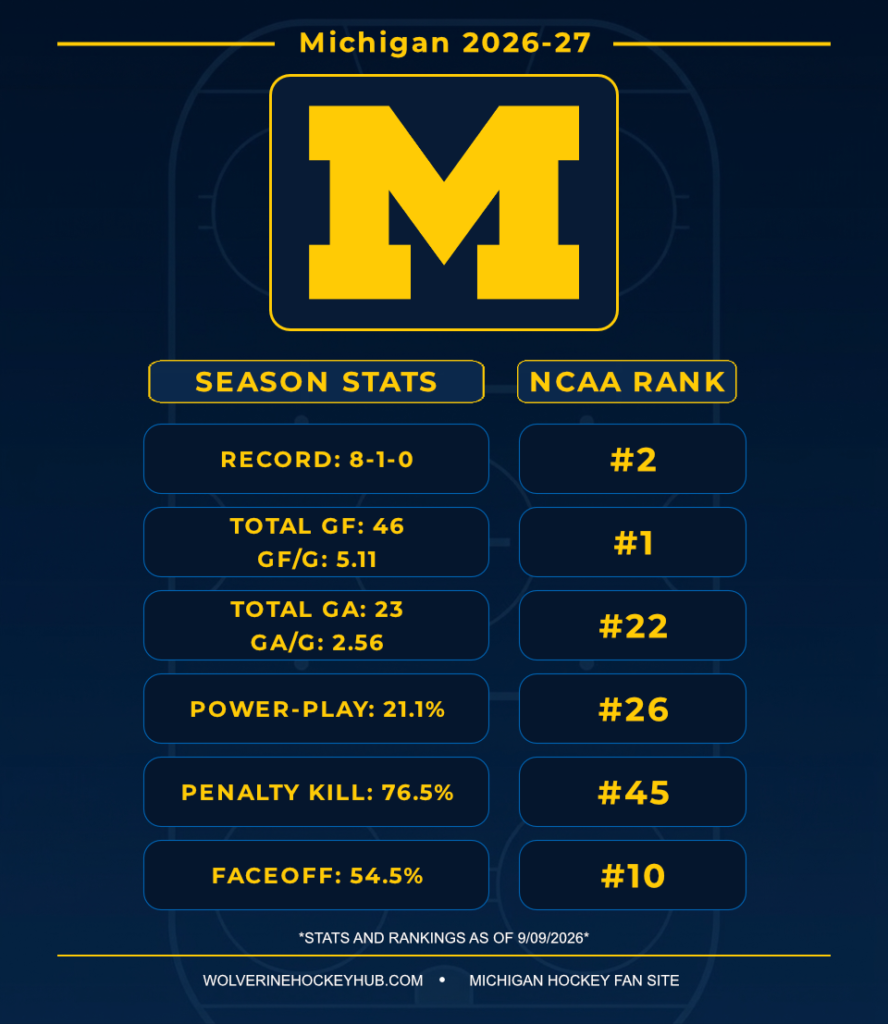
Michigan has the top offense in the country, scoring 46 goals this season. A lot of that is thanks to the incredible starts that Hage and Perron have had. This team has scoring ability all down the lineup, though. The Wolverines aren’t the cream of the crop defensively, but they’re doing fine in that regard. They mostly rely on having the puck in the offensive zone and Ivankovic bailing them out when needed.
The area I’m most concerned with is special teams. We’re far enough along now that I can’t use the early-season excuse. Both the power play and penalty kill could use improvement.
The power play is clicking at 21.1%, which isn’t that bad. However, with the offensive talent this team has, I expect them to be scoring more frequently on the power play. Wisconsin, for example, has had one fewer power-play attempt than Michigan, yet they have double the power-play goals of Michigan, converting at nearly 50%. The Badgers might be overachieving, but I do believe the Wolverines should be able to be closer to 35% power-play conversion.
The penalty kill is a point of concern right now. Michigan is in the lower half of the NCAA at killing penalties at 76.5%. Ideally, I would like to see them killing at least 80% of penalties. Hopefully, they took the time during this bye week to work on it.
Top Performers
A handful of Wolverines have stood out and helped Michigan get off to a hot start. Some have met expectations, and some have exceeded them.
Michael Hage is playing as well as I had hoped he would in his junior year. He leads the team and the nation in points with 20 in nine games. He is the motor that drives Michigan this season. The series against Ohio State is proof of that. In Michigan’s only loss this year, Hage had no points. He then followed up that loss with a five-point game to get the Wolverines back in the win column. He’s put himself well into the early Hobey Baker conversation.
Jayden Perron was a point-per-game player for Michigan last season. This season, he’s on pace to double his point totals from the previous year. His 19 points in nine games are second-best both on the team and in the nation. He had a seven-game goal streak to start the season, and is tied for most goals in the nation with 10. He and Hage have made up a lethal duo.
Drew Schock has been a pleasant surprise so far. He currently leads Michigan defenders with 11 points and leads the team in +/- at +16. I didn’t have him pegged for this kind of output, but it’s great to have the extra scoring depth on the blue line.
Malcolm Spence and Cole McKinney have come out of the gate and impressed. Both have six goals in nine games, and Spence has one more point than McKinney with 10 and 9, respectively. In my season preview, I mentioned how these two could step up and take bigger roles, and they have. They’ve been on what’s been a solid second line along with Nick Moldenhauer for the majority of games this season. These two are on pace to surpass their point totals from last year, but I expect that pace to slow a bit for both of them. They both have a shooting percentage of .300 or better, which is bound to come back down to average eventually. Until then, I’m happy to get all the production we can from them.
Landon DuPont came into this year with all the hype of being the potential first overall pick in the upcoming NHL draft. While he hasn’t dominated every game and taken the NCAA by storm, he has been really good. DuPont was scratched for one game against Denver, so he’s only played eight games this year. In those eight games, he has eight points, all assists. He’ll find the back of the net eventually. Even if he doesn’t, he is playing well enough to be a difference-maker. For those doubting him, let me give some comparables from past Michigan defenders’ first eight games: Luke Hughes 7 Pts (2G, 5A), Zach Werenski 6 Pts (2G, 4A), Quinn Hughes 5 Pts (1G, 4A). Each of these players scored by this point in the season, but DuPont has more points than they had. I’m not worried about DuPont.
Jack Ivankovic has been steady in net for Michigan as expected. He was a big part of sweeping Denver, and he leads the NCAA in wins with eight. He has a respectable 2.33 GAA and a .921 save percentage. Ivankovic has started every game so far, and he will likely start every game the rest of the way.
Missing Expectations
Now let’s look at a few players that haven’t quite hit the expectations that I had set for them. It is still early in the season, so there’s definitely time for these guys to turn things around. And missing my expectations doesn’t mean they’re bad players. I’ll explain what I mean for each player.
Will Horcoff plays on the top line with Hage and Perron and has eight points in nine games played. Calling a nearly point-per-game player underperforming sounds harsh, but when his linemates more than double his points, it’s hard to ignore. I know there are only so many points to go around too, but Hage and Perron are finding them easier. Horcoff was moved off the top line for two games and managed only one assist that came on the power play. If he keeps playing on the top line, I’m fine with his pace as long as he keeps making room for Hage and Perron. If he plays down the lineup, then he needs to drive the line he’s on.
J.P. Hurlbert has two goals and two assists in nine games. His first goal was in the season opener, and his second goal was in Michigan’s most recent victory. That means he had a seven-game goalless streak, which is not what you want from someone who was labeled as a goal scorer. I expected more from him, but I also didn’t expect him to be on the fourth line. Perhaps he’d be more productive playing with more skilled players. We’ll have to see if he can work his way up the lineup.
Jack Nesbitt has been up and down between second and third line. Through nine games, he only has one goal and two assists. With the minutes he’s been given, I expect a little more from him offensively. And if he’s not going to put up points, I expected him to be a shutdown guy. That hasn’t really worked out either. On a team with a +23 goal differential, Nesbitt has a +/- of -1. For someone who was touted as a good two-way player, it’s surprising to get neither offense nor defense from him. I need to see more from him at both ends of the rink the rest of the season.
Adam Valentini doesn’t have the stat line that fellow sophomores Spence and McKinney have, but I’m not overly concerned yet. Valentini has two goals and one assist in nine games, and that’s playing lower in the lineup than his second-year counterparts. My main reason for not worrying about him is his shooting percentage, which is currently at .091, while having the fourth-most shots taken on the team. He’s at the opposite end of the spectrum as Spence and McKinney when it comes to shooting percentage, and I expect that he can get back up to the average. It may just take a little more puck luck.
Cam Reid has three assists and no goals in nine games played. I expected him to be more of an offensive threat, but that’s just not been the case so far, partially because Henry Mews has been getting more of the offensive opportunities that I thought Reid might get. If he doesn’t have quite the offensive outburst I expected, but continues to play well defensively, I will be happy.
The Mazie and Blue are in good shape this season. Their record is evidence of that. There’s always room to improve, though. They play tough opponents in their next stretch of games, including Michigan State and Wisconsin. But first up this weekend is Penn State. I hope they keep this strong start going deeper into the season. Go Blue!